Introduction in TechStack
Modern blockchain networks, including those built on Bitcoin’s architectural principles, rely on transparent peer-to-peer communication channels that were never designed with strong transport-layer security in mind. While the blockchain itself provides immutability and cryptographic guarantees for on-chain data, all off-chain interactions between participants – including transaction propagation, block distribution, and coordination of network state – remain exposed to adversarial observation and manipulation. The conceptual model illustrated above highlights this asymmetry: on-chain data enjoy inherent protection, yet the off-chain communication pathways responsible for transporting that data are transmitted in plain form, allowing attackers to intercept, analyze, and exploit network traffic.
The absence of confidentiality, authenticity, and integrity at the transport level enables a wide range of attacks, such as passive traffic monitoring, deanonymization through flow analysis, reconstruction of network topology, malicious routing, censorship of specific messages, and injection or modification of in-transit data. These vulnerabilities arise because Bitcoin’s native TCP connections do not employ encryption or authenticated message protection. Meanwhile, participants frequently exchange sensitive off-chain information, negotiate session keys, and rely on peer communication to maintain the overall consistency and reliability of the network.
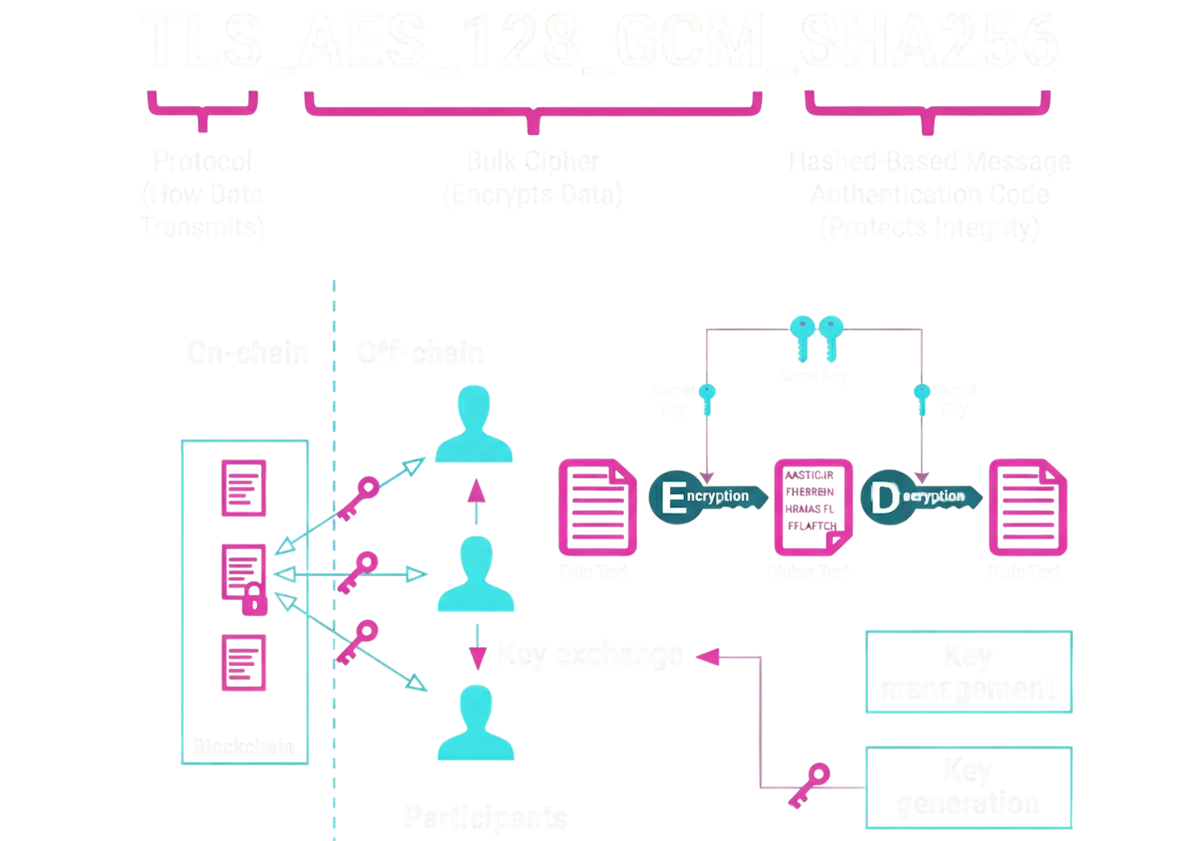
The conceptual diagram demonstrates a natural path forward: integrating a secure communication layer that governs key generation, key exchange, encryption, and decryption as part of the node interaction model. By establishing a unified cryptographic pipeline – represented by TLS_AES_128_GCM_SHA256 – nodes can ensure that all off-chain communication channels become confidential, authenticated, and tamper-resistant, while the blockchain remains responsible for anchoring trust and preserving verifiable state. The result is a strengthened architecture in which secure key management and protected message exchange mitigate the transport-layer weaknesses that currently affect Bitcoin-like networks.
Justification and statement of the problem
The base Bitcoin protocol uses unencrypted persistent TCP connections between nodes in the peer-to-peer network. It does not provide confidentiality, authenticity, or integrity guarantees at the transport layer. This makes it possible for an adversary to perform passive traffic monitoring, deanonymize users through traffic analysis, reconstruct the network topology, conduct eclipse attacks, route traffic through malicious intermediaries, selectively censor transactions, and modify messages in transit.
Research on the security of the Bitcoin P2P layer points out the absence of a strong transport security model and directly or indirectly calls for the introduction of traffic protection mechanisms. The goal is to justify the use of an SSL/TLS based technology stack on top of a blockchain compatible with Bitcoin, in order to improve confidentiality, integrity, authenticity, and robustness of data transmission between nodes, without changing the consensus layer.
Choice of Cryptographic Foundation
The cryptographic foundation of the proposed stack is based on TLS 1.3 together with the cipher suite TLS_AES_128_GCM_SHA256. TLS 1.3 is selected as the transport–level security protocol, and the cipher suite defines the specific algorithms used for bulk encryption, integrity protection, and key derivation. This combination is intended to provide a high and rigorously analyzed level of security while remaining performant enough for a large-scale peer-to-peer blockchain network.
The choice in favor of a standardized and widely deployed protocol is driven by the need to rely on well studied cryptographic constructions and battle-tested implementations instead of designing a custom protocol for the blockchain network, which would significantly increase the attack surface and the risk of design errors.
Rationale for Selecting TLS 1.3
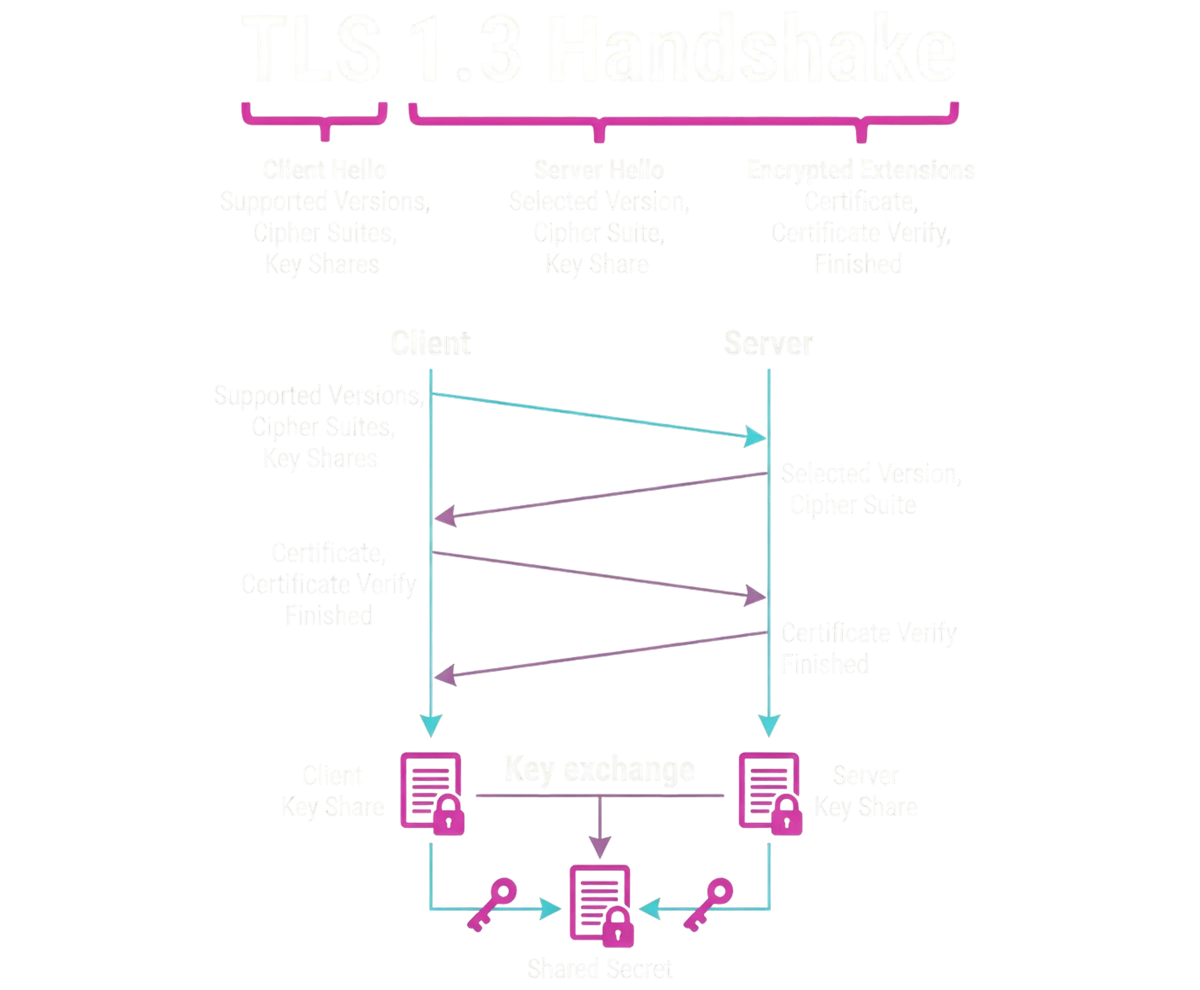
TLS 1.3 is the current version of the Transport Layer Security protocol that focuses on providing authenticated encryption with forward secrecy, minimizing handshake latency, and eliminating legacy insecure mechanisms. For a Bitcoin-like network, this protocol is attractive because it combines strong security properties with optimizations suitable for systems with a high number of connections and strict performance requirements.
TLS 1.3 provides the following key properties relevant to a blockchain network:
- Authenticated encryption of application data using AEAD schemes, which simultaneously ensures confidentiality and integrity.
- Forward secrecy based on ephemeral key exchange mechanisms, which protects past communications even if long-term keys are compromised in the future.
- Reduced number of round trips during the handshake, which lowers connection setup latency – an important factor for peer–discovery and reconnection in a global P2P network.
- Support for session resumption, which decreases the cost of repeated connections between the same peers.
- Removal of outdated ciphers and key exchange mechanisms, reducing the overall attack surface.
In addition, TLS 1.3 has multiple independent, audited implementations and benefits from hardware acceleration and optimization in operating systems and libraries. This significantly simplifies integration into existing node software and reduces the probability of implementation–level vulnerabilities compared to a custom protocol.
Rationale for Selecting the Cipher Suite
The cipher suite TLS_AES_128_GCM_SHA256 combines AES–128 in Galois/Counter Mode (GCM) as the AEAD algorithm with SHA–256 as the hash function used for key derivation and message authentication. This combination is widely recommended and considered a practical standard for TLS 1.3 deployments, offering a good balance between security and performance.
The choice of this particular suite can be justified by the following arguments:
- Cryptographic strength of AES–128. AES–128 provides approximately 128–bit security, which is considered sufficient for the foreseeable future in most realistic scenarios. At the same time it requires fewer computational resources than AES–256, which is important for a high–throughput peer–to–peer network.
- Use of AEAD mode GCM. GCM provides authenticated encryption, meaning that ciphertexts are both confidential and integrity–protected. This simplifies design and reduces the risk of compositional errors that can arise when encryption and authentication are implemented as separate mechanisms.
- Efficiency and parallelism. GCM can be efficiently implemented using vector instructions and hardware acceleration, and AES instructions are widely supported in modern CPUs. This allows nodes to encrypt and decrypt large volumes of data with minimal CPU overhead.
- Use of SHA–256. SHA–256 is already a core primitive in the Bitcoin protocol. It is used for block hashing and other cryptographic constructions. Reusing the same hash function in the TLS stack simplifies library reuse, implementation, and auditing.
- Standardization and analysis. TLS_AES_128_GCM_SHA256 is part of the TLS 1.3 standard and has undergone extensive public analysis. Its use aligns the blockchain transport security model with widely accepted and verified industry practices.
In summary, the TLS_AES_128_GCM_SHA256 cipher suite provides sufficient cryptographic strength, high performance, and implementation convenience for integration into a Bitcoin–based blockchain network.
Architecture of TLS Integration into a Bitcoin–Like Blockchain
The proposed architecture assumes that TLS is added as a security layer at the transport level between nodes and between nodes and external clients. Importantly, this does not require changing the transaction structure, block format, or consensus rules. The integration affects only the way network messages are transported and protected.
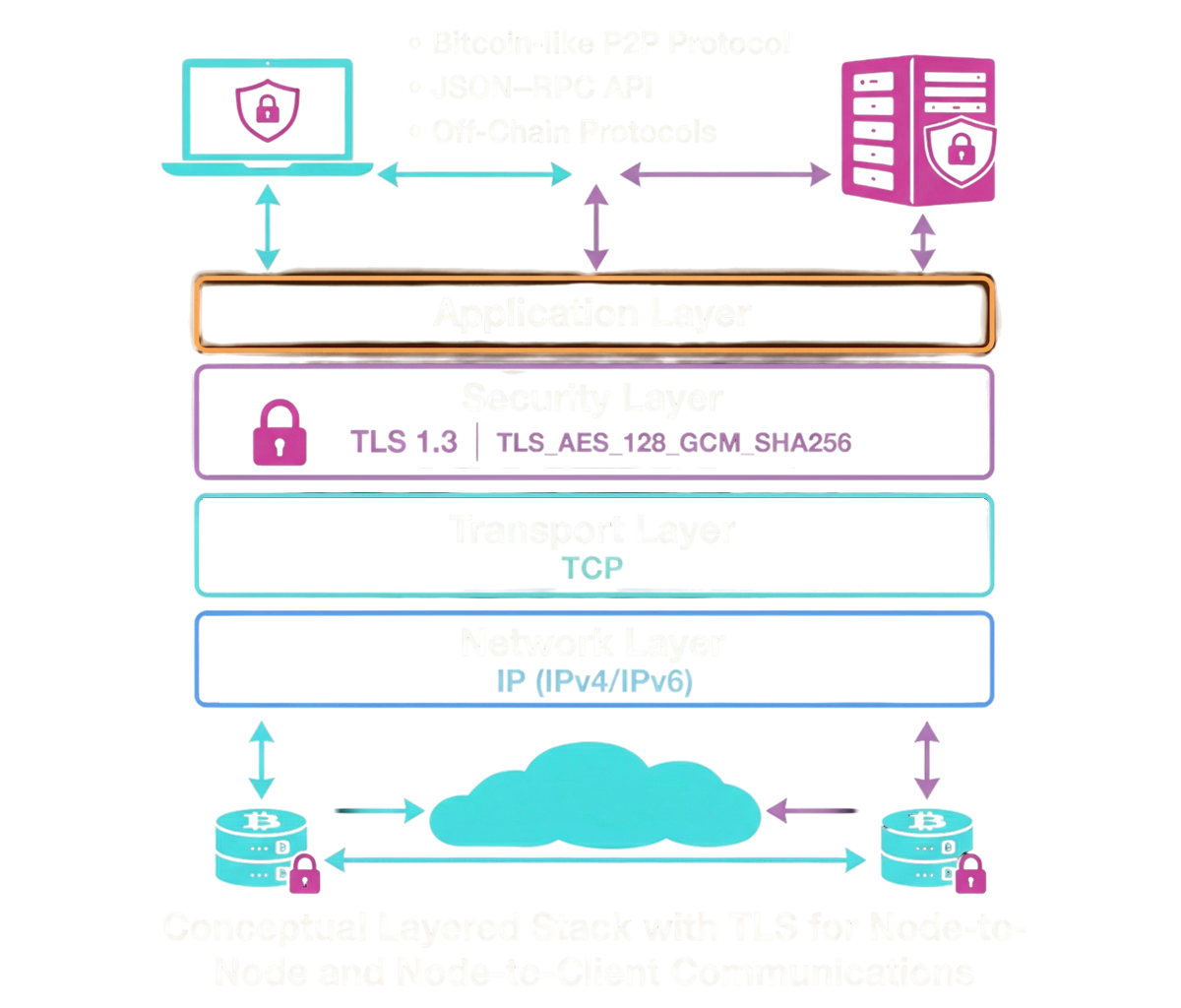
The conceptual layered stack for node–to–node and node–to–client communications can be represented as follows:
- Network layer: IP (IPv4/IPv6).
- Transport layer: TCP.
- Security layer: TLS 1.3 with the TLS_AES_128_GCM_SHA256 cipher suite.
- Application layer:
- Bitcoin–like P2P protocol for propagating blocks and transactions.
- JSON–RPC or similar APIs for control, monitoring, and client interactions.
- Off–chain protocols for exchanging additional data whose commitments are recorded on–chain.
This architecture makes it possible to encrypt and authenticate all critical communications while preserving the existing consensus logic and data format. Nodes that support TLS can establish secure channels, while legacy nodes may still operate using plain TCP, enabling a gradual migration strategy.
TLS Integration for Node Communications
When two nodes establish a connection, instead of immediately exchanging version and capability messages over plain TCP, they first perform a TLS 1.3 handshake. After the handshake is completed and a shared session key is established, all P2P protocol messages are transmitted inside the encrypted TLS channel.
From the point of view of the P2P protocol, nothing changes: message formats, sequencing, and validation rules remain the same. Only the transport medium is now encrypted and integrity–protected. This provides confidentiality and authenticity against a man–in–the–middle adversary and makes passive traffic classification significantly harder.
Node Authentication and PKI Models
The use of TLS opens up several options for authenticating nodes and clients. Depending on the network’s security requirements, one may choose from different public key infrastructure models and levels of trust. In all cases, blockchain can serve as an additional anchor for public keys or certificate metadata.
Possible authentication models include:
- Server–side authentication for client–node connections. Nodes acting as servers can present certificates that clients verify to ensure they are communicating with an authentic node rather than a man–in–the–middle adversary. This is especially important for lightweight clients that do not hold the full blockchain and rely on remote nodes for validation data.
- Mutual authentication (mTLS) between nodes. Each node possesses a long–term identity key and certificate. When two nodes connect, both verify each other’s certificates. This makes it significantly harder to introduce malicious nodes that pretend to be honest peers.
- Blockchain–anchored PKI. Public keys or certificate fingerprints of trusted authorities or individual nodes can be recorded on–chain through special transactions. The blockchain becomes a decentralized, immutable registry of trust anchors and revocation information. This reduces dependence on centralized certificate authorities and makes trust relationships auditable.
- Opportunistic encryption without strict authentication. Even if strict identity verification is not used, simply encrypting the traffic with TLS already protects against passive monitoring and raises the cost of network–level attacks. This mode can be used as a transitional step.
These models may coexist, allowing different security levels for different roles: for example, strict mutual authentication for backbone nodes and opportunistic encryption for edge nodes or experimental networks.
Integration with On–Chain Logic
Beyond transport–level protection, the integration of TLS with a Bitcoin–based blockchain enables using the blockchain itself as a secure registry and evidence store for TLS–related cryptographic material. This conceptually merges transport security with the immutable ledger, providing stronger guarantees and new protocol design possibilities.
On–chain data can be used to anchor trust roots, certificates, or proof artifacts that relate to TLS sessions or PKI state. This allows nodes and external systems to verify that a given TLS configuration or identity state is consistent with on–chain information and has not been silently modified by a centralized authority.
On–Chain Anchoring of Cryptographic Anchors and PKI Data
The blockchain can serve as a public, append–only, tamper–resistant database for critical PKI elements. Instead of relying solely on traditional certificate authorities and revocation lists, one can store in the blockchain:
- Hashes or fingerprints of root and intermediate CA certificates used for TLS.
- Mappings between node identifiers and their public keys or certificates.
- Revocation records for compromised or no longer trusted keys.
- Audit trails of certificate issuance and key rotation.
Such anchoring provides verifiable guarantees that a particular key or certificate was known and accepted by the network at a given point in time. Any attempt to substitute or silently change trust roots would be detectable by comparing current TLS configuration against on–chain records.
Off–Chain Data Exchange and On–Chain Commitments
In many scenarios, only commitments or hashes of data are recorded on–chain, while the actual payload is exchanged off–chain between participants. TLS channels are a natural mechanism for protecting such off–chain communications, ensuring confidentiality and integrity of the exchanged data.
Participants can negotiate and transfer data over TLS while simultaneously writing cryptographic commitments (for example, hashes or Merkle roots) to the blockchain. This creates a cryptographically verifiable link between the on–chain state and off–chain interactions. Later, if needed, a party can prove that certain data were exchanged by combining blockchain records with logs or transcripts of the TLS–protected communication.
Security Analysis and Network Impact
The introduction of TLS into a Bitcoin–like network aims to reduce the attack surface at the transport layer. It directly addresses several concrete threat classes that are difficult or impossible to mitigate using only application–layer and consensus–layer mechanisms.
A structured analysis of threats demonstrates which risks are mitigated and how TLS integration affects the behavior of adversaries attempting network–level attacks.
Threats Mitigated by TLS Integration
The use of TLS with authenticated encryption and optional authentication of endpoints mitigates several critical threats that exist in the original Bitcoin network design with unencrypted TCP connections.
The main improvements include:
- Protection against passive traffic monitoring and deanonymization. Encrypted traffic hides message contents and significantly complicates classification of different P2P message types. This reduces the feasibility of deanonymization attacks based on timing and content correlation.
- Resistance to man–in–the–middle attacks. When certificates or public keys are properly authenticated, an adversary cannot silently intercept and modify traffic between nodes. Any attempt to impersonate a node is detected during the TLS handshake.
- Integrity protection against message tampering. AEAD modes such as AES–GCM ensure that any modification of encrypted messages results in authentication failures. Injecting, deleting, or altering P2P messages without detection becomes impossible for an attacker who does not possess valid keys.
- Increased difficulty of targeted censorship. Since the content and type of messages are hidden from intermediate routers and network providers, selectively filtering transactions, blocks, or specific message types becomes much more difficult without active participation in the TLS session.
- Improved security of lightweight clients. SPV and similar clients that rely on remote nodes can use TLS authentication to ensure they are communicating with legitimate nodes, reducing the risk of being served a manipulated view of the blockchain.
Overall, TLS integration transforms a transparent and easily observable network into one where adversaries must expend significantly more resources to gather information or influence traffic.
Performance Considerations
Any introduction of encryption and authentication at the transport layer raises concerns regarding performance, especially for global peer–to–peer networks with many connections and high data volumes.
However, practical experience and theoretical estimates indicate that the overhead of TLS with AES–GCM is acceptable for a Bitcoin–like network.
The main arguments in favor of acceptable performance are:
- Hardware acceleration. AES and GCM have hardware support in most modern CPUs. This allows encryption and decryption to be performed at high speed with relatively low CPU load.
- Handshake optimization in TLS 1.3. The reduced number of round trips and support for session resumption lower the cost of establishing secure connections, which is particularly important for nodes with dynamic peer sets.
- Amortization over long–lived connections. Node–to–node links in blockchain networks are often long–lived. The initial handshake cost is amortized over a large amount of transmitted data, making its relative impact small.
- Real–world precedents. Other blockchain projects and high–load distributed systems successfully use TLS as the primary transport security mechanism, demonstrating that its overhead is manageable in practice.
Thus, the performance impact of TLS 1.3 with AES–GCM is compatible with the operational requirements of a Bitcoin–based Node Blockchain Network, especially if implementations are optimized and take advantage of available hardware support.
Comparison with Native Bitcoin Transport Solutions
In the Bitcoin ecosystem, there are native proposals for encrypting peer–to–peer traffic, such as BIP324. These proposals define custom handshake and encryption mechanisms tailored specifically to the Bitcoin P2P protocol. At the same time, TLS provides a generalized and standardized approach to secure transport that is not limited to a single application protocol.
From a scientific and engineering perspective, the use of TLS can be justified by the following considerations:
- Reuse of existing, thoroughly analyzed cryptographic constructions and implementations instead of designing a new protocol from scratch.
- Compatibility with a wide range of external systems and tools that already rely on TLS, including browsers, monitoring systems, and enterprise middleware.
- Ability to use common PKI infrastructures and, at the same time, extend them with blockchain–anchored trust models.
- Flexibility in supporting not only node–to–node communication but also a variety of off–chain and service–level communication patterns.
Native Bitcoin transport encryption and TLS are not mutually exclusive. TLS can be used for client–facing and off–chain services, while specialized protocols can optimize the core P2P network. This layered approach maximizes flexibility and allows different security and performance trade–offs to be applied where they are most appropriate.
Final Scientific Justification of the Technology Stack
The integration of an SSL/TLS–based stack into a Bitcoin–like blockchain network is scientifically and technically justified as a way to strengthen security at the transport layer without altering consensus rules or fundamental blockchain structures. TLS 1.3, together with the TLS_AES_128_GCM_SHA256 cipher suite, provides a combination of confidentiality, integrity, authenticity, and forward secrecy that addresses key weaknesses of the original unencrypted P2P transport.
The main points of the justification can be summarized as follows:
- The original Bitcoin network lacks a strong security model at the transport level, which exposes it to passive surveillance, manipulation, and censorship attempts.
- TLS 1.3 is a standardized, well studied protocol that offers modern cryptographic guarantees, reduced handshake latency, and broad implementation support.
- The TLS_AES_128_GCM_SHA256 cipher suite balances cryptographic robustness with high performance and aligns with primitives that are already central to the Bitcoin ecosystem.
- Integrating TLS at the transport layer does not require changing the consensus layer or data formats, enabling a gradual and backward–compatible deployment.
- Using the blockchain as a registry for PKI data and TLS–related cryptographic anchors creates new possibilities for decentralized, auditable trust management.
- Empirical evidence and theoretical analysis indicate that the performance overhead of TLS with AES–GCM is acceptable for high–load, global networks.
Consequently, the TLS–based technology stack can be considered a scientifically grounded and practically viable solution for increasing the security of a Bitcoin–based blockchain network and for ensuring protected data transmission between nodes and external participants.